Rear Axle Seal 643 Diesel

Skidsteer Forum - Bobcat, New Holland, Case, John Deere

Help Support Skidsteer:

dangrego

Active member
Joined
Oct 19, 2025
Messages
31
Hi...anyone know how to replace rear axle seal in a 1986 Bobcat 643 Diesel skidsteer? There is nothing for this problem on a 643 on YouTube. I'm guessing I have to drain the chaincase and crack open the hatch in the rear of the machine (like you would on a differential on a car or truck) to access a big nut to release the axle? Service manual didn't help much...I'm really flying blind on this one. Any help is appreciated. Thanks.
 
Hi...anyone know how to replace rear axle seal in a 1986 Bobcat 643 Diesel skidsteer? There is nothing for this problem on a 643 on YouTube. I'm guessing I have to drain the chaincase and crack open the hatch in the rear of the machine (like you would on a differential on a car or truck) to access a big nut to release the axle? Service manual didn't help much...I'm really flying blind on this one. Any help is appreciated. Thanks.
Not easy to get to those bolts. But you are correct about opening the back access cover to get to the bolt.
I actually jacked up my 742 and braced the frame and then removed the entire chain case for easier access. He problem is the chain and sprocket are hard to deal with in the back once the bolt is removed.

Take a look at the parts catalog to see what all needs to be done to get the axel out. Also, if you have play with the axels in and out, Bobcat sells special washers that go under the axle bolt with different spacing on each side to take out the slop. You can also have a machine shop make them.

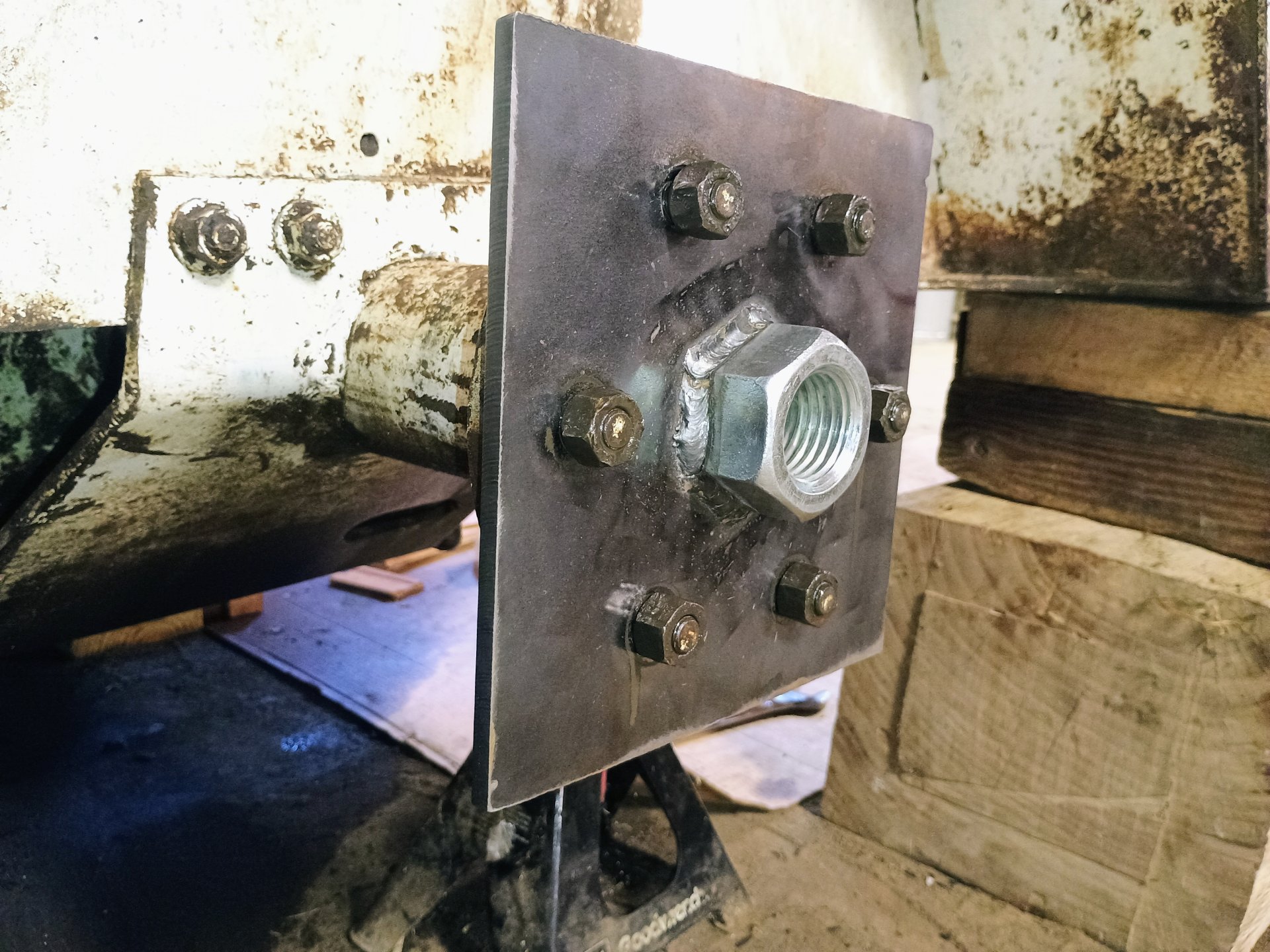
One trick is to place the wrench on the bolt, jamb the wrench against the chain case, and then turn the axle from the outside. I made a makeshift adapter that bolted to the lugs that had a large nut welded to the center so I could put a large wrench with cheater on it to turn the axle.

Buy the way the toque on those axle bolts is huge. My 742 the torque spec. was 300 ft-lbs. I had to buy a bigger torque wrench just for that.
 
Last edited:
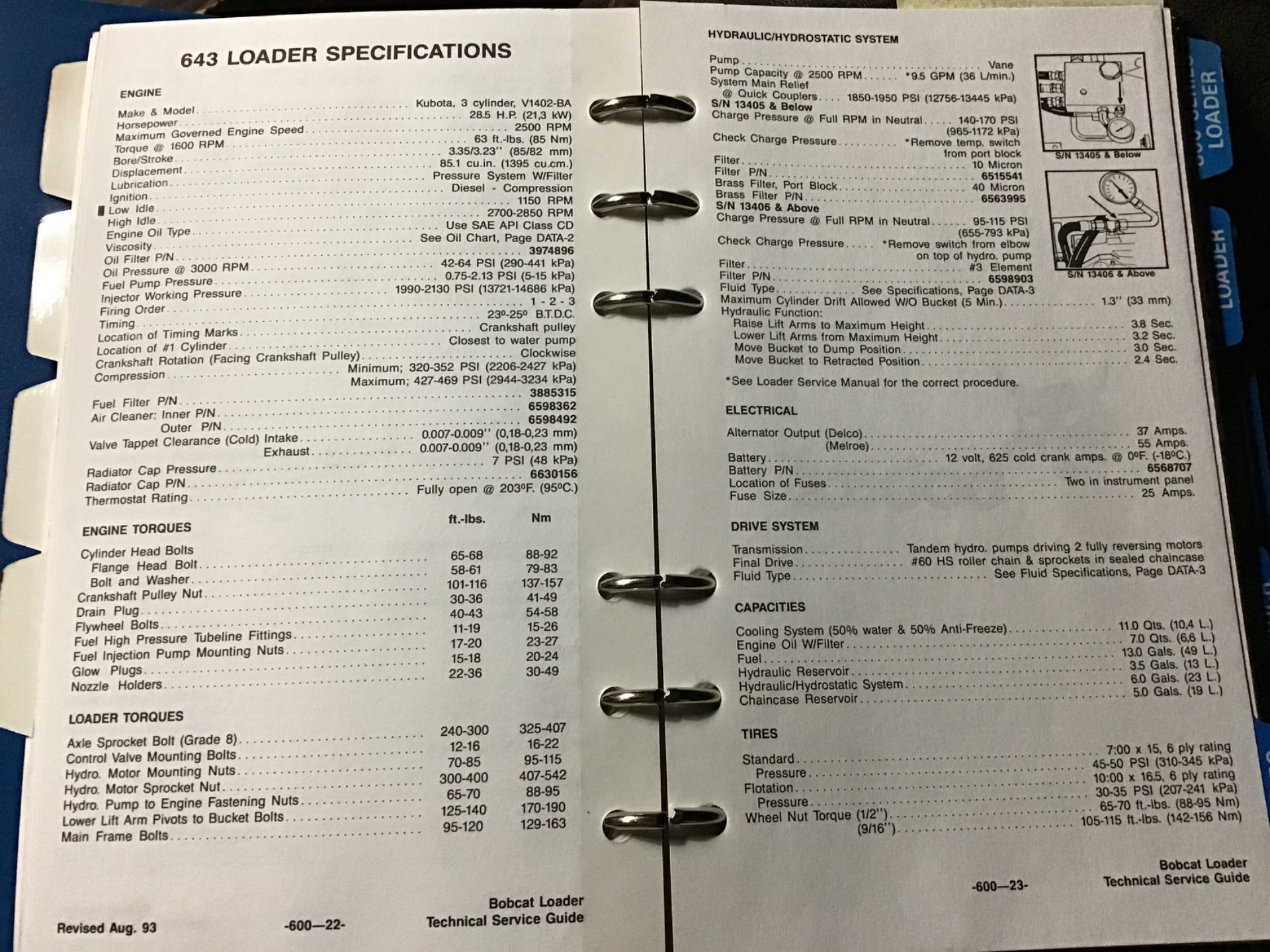
I found the loader specifications for a 643, see attached photo.
Your axle bolt torque 240-300 ft-lbs
 

Attachments

  • IMG_0824.jpeg
    IMG_0824.jpeg
    896.4 KB
Wow thanks almost overwhelming though I think I'm going to use some wood to stick in there and shim up the big gear and chain assembly and then just take that nut off somehow and go from there... I'm assuming that once I remove that bolt that the big sprocket and chain will want to go with gravity so that's why I mentioned supporting it.
 
I found the loader specifications for a 643, see attached photo.
Your axle bolt torque 240-300 ft-lbs

Great source of information, thanks' a mill!

If you allow me to kidnap this post for just one message as I've just messured the hydraulic pressure directly on one of the AUX quick connectors and got a readout of ~1875PSI. Is this the same as messuring the pressure of the system main relief valve that in the spec says 1850-1950 PSI? It's a 643 diesel by the way.
 
I’m not positive but since the specifications say “System Main Relief @ Quick Couplers” I believe that is what they are talking about. The only “Quick Couplers” on a 743 are the auxiliary couplers.

Maybe someone else can answer this better than me.
 
As an Amazon Associate we earn from qualifying purchases. Product prices and availability are accurate as of the date/time indicated and are subject to change.
I’m not positive but since the specifications say “System Main Relief @ Quick Couplers” I believe that is what they are talking about. The only “Quick Couplers” on a 743 are the auxiliary couplers.

Maybe someone else can answer this better than me.

Yes it's the same on the 643 as there are only two quick connectors on the whole machine which are in front of your left knee (outside the cab that is). Reason for me measuring at the AUX is that I find my lift and tilt (same hydraulic system as the AUX) to be really weak but the odd thing is that it seems to fluctuate! Some times after sitting for a while the lift/tilt seems to work okay but other times the machine can hardly lift the bucket off the ground :rolleyes:

I've already cleaned the hydraulic tank, obviously changed the oil, changed the hydraulic filter and am now scratching my head... Any ideas?

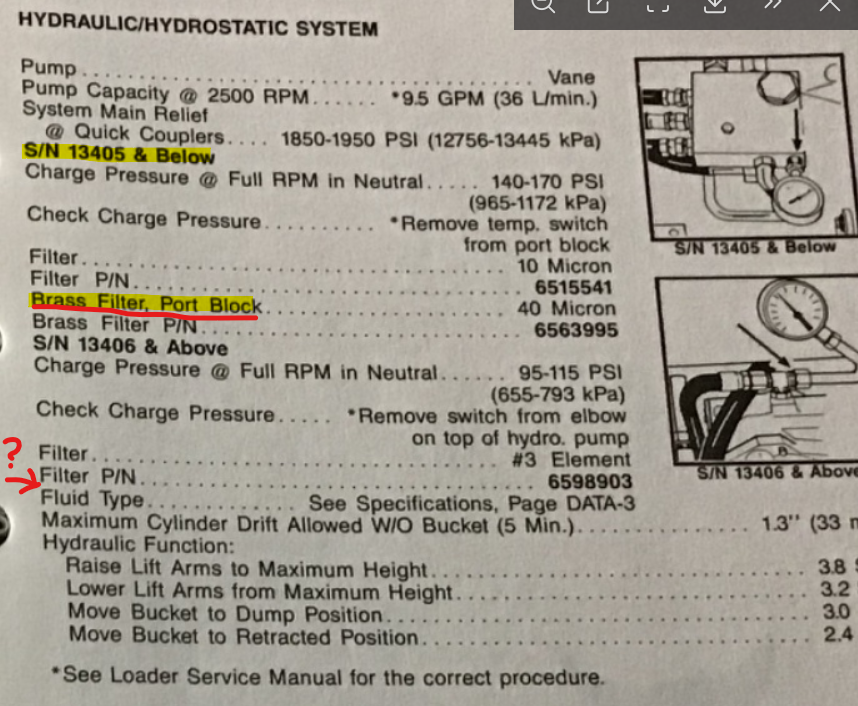
Also in the spec that you posted it refers to the small brass filter in the port block for older machines but I can't see any reference to such a filter for machines with higher serial number (mine = 21766), I guess this means that there are no brass filters in these newer blocks or am I mistaken?

1761028492092.png
 
Last edited:
It is possible that there is no filter on the later models. One of the problem with the older machine references, in all of Bobcat manuals, is that they lumped so many serial numbers together that parts listed may or may not be in a particular machine in the serial number range. It seems to get worse when you have a manual that that has a range of serial number with the “and above” and your machine lands in that category. Sometimes there were manual updates that did not make it into all manuals.

What I normally do to try and find filters on specific machines from the parts list is to enter the machines serial number and then search “filter”. Look at the schematic and check the box next to “View Search Results Only”. It will then only list the results with the word “filter” in them. Then if you click on the part in the list it will highlight the number on the schematic.

I think you are on the correct path for finding your hydraulic problem. There could be a piece of debris that is in the system somewhere. Last resort, you may need to remove and clean out everything on that circuit. There is a similar issue on a newer model ( can’t remember which) where a small part in the circuit was coming loose and intermittently blocking a bend in the hydraulics. The fix was to remove the line, get the loose part out and put it back together without replacing the bad part. It was like a check valve that was never actually needed.
 
1000002623.jpg
okay well my post got hijacked a little bit but that's fine I'm fine with it just want to make note of that so that we keep continuity at some point and so I'm working on the hydraulic valve leak and waiting for a big socket that will fit on this b**** and then we'll go from there you can see that I had a piece fabricated for me to turn the axle to finally fix the axle seal leak.
 
View attachment 9941okay well my post got hijacked a little bit but that's fine I'm fine with it just want to make note of that so that we keep continuity at some point and so I'm working on the hydraulic valve leak and waiting for a big socket that will fit on this b**** and then we'll go from there you can see that I had a piece fabricated for me to turn the axle to finally fix the axle seal leak.
That’s better than the one I made. Hang it on a wall somewhere where it won’t get lost because you will need it in the future for the other axles. You can also rent it out to other people that need it.

It makes the job way easier.
 
That’s better than the one I made. Hang it on a wall somewhere where it won’t get lost because you will need it in the future for the other axles. You can also rent it out to other people that need it.

It makes the job way easier.
Absolutely sir The reason I had it made so good is for good luck so that I don't have to do the other three but if I do you know there it is ...way less stress.
 
It is possible that there is no filter on the later models. One of the problem with the older machine references, in all of Bobcat manuals, is that they lumped so many serial numbers together that parts listed may or may not be in a particular machine in the serial number range. It seems to get worse when you have a manual that that has a range of serial number with the “and above” and your machine lands in that category. Sometimes there were manual updates that did not make it into all manuals.

What I normally do to try and find filters on specific machines from the parts list is to enter the machines serial number and then search “filter”. Look at the schematic and check the box next to “View Search Results Only”. It will then only list the results with the word “filter” in them. Then if you click on the part in the list it will highlight the number on the schematic.

I think you are on the correct path for finding your hydraulic problem. There could be a piece of debris that is in the system somewhere. Last resort, you may need to remove and clean out everything on that circuit. There is a similar issue on a newer model ( can’t remember which) where a small part in the circuit was coming loose and intermittently blocking a bend in the hydraulics. The fix was to remove the line, get the loose part out and put it back together without replacing the bad part. It was like a check valve that was never actually needed.

It is possible that there is no filter on the later models. One of the problem with the older machine references, in all of Bobcat manuals, is that they lumped so many serial numbers together that parts listed may or may not be in a particular machine in the serial number range. It seems to get worse when you have a manual that that has a range of serial number with the “and above” and your machine lands in that category. Sometimes there were manual updates that did not make it into all manuals.

What I normally do to try and find filters on specific machines from the parts list is to enter the machines serial number and then search “filter”. Look at the schematic and check the box next to “View Search Results Only”. It will then only list the results with the word “filter” in them. Then if you click on the part in the list it will highlight the number on the schematic.

I think you are on the correct path for finding your hydraulic problem. There could be a piece of debris that is in the system somewhere. Last resort, you may need to remove and clean out everything on that circuit. There is a similar issue on a newer model ( can’t remember which) where a small part in the circuit was coming loose and intermittently blocking a bend in the hydraulics. The fix was to remove the line, get the loose part out and put it back together without replacing the bad part. It was like a check valve that was never actually needed.

Thanks' a mill' @brdgbldr and once again sorry @dangrego for leading this thread a bit astray. Now let's focus on your challenge from now on in here. 🤗
 

Latest posts

Back
Top